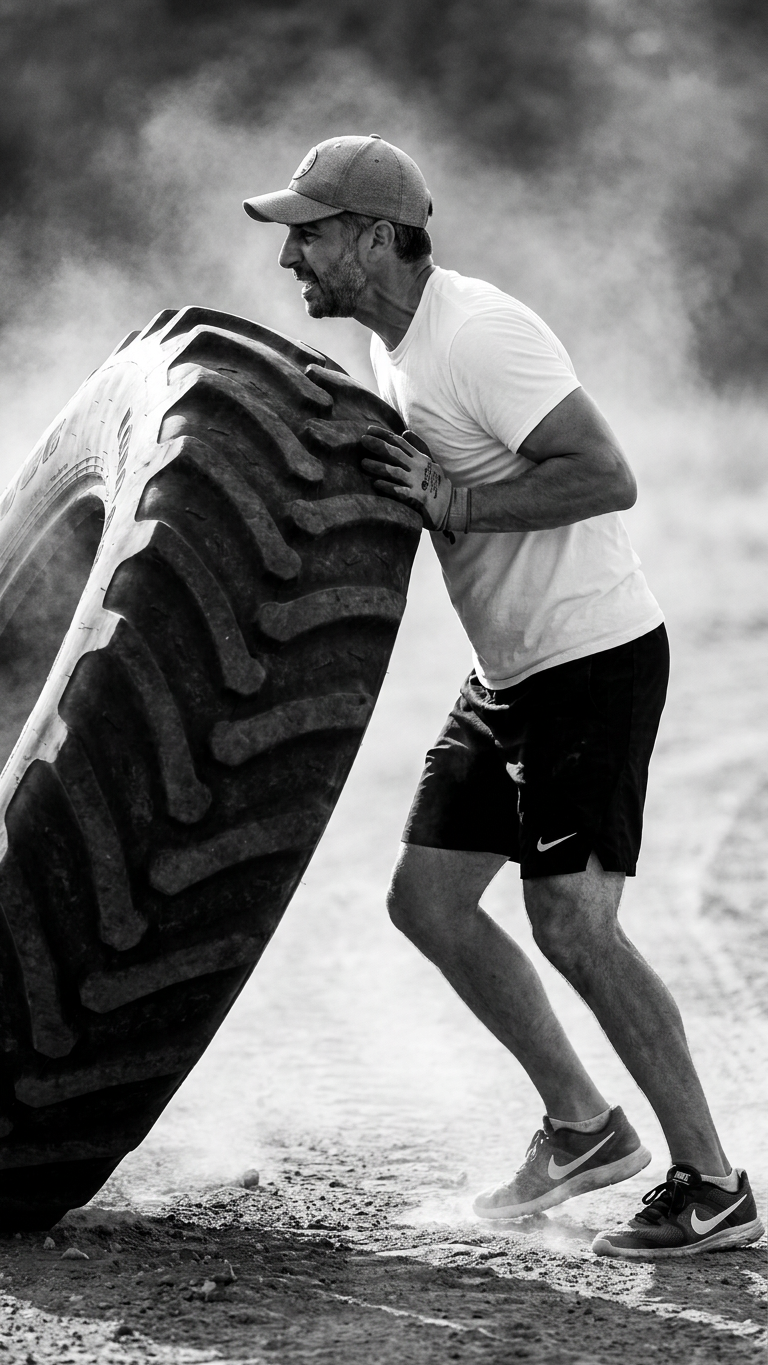
The tire weighed somewhere between 200 and 400 pounds. I never knew the actual number. Tractor tire. Cracked rubber. Sun-faded. Dust caked into the treads. It sat at the edge of the yard at Lompoc and most days nobody touched it.
I would.
Quarter mile run. Get to the tire. Dig my hands underneath the lip — gloves on (cheap, used, in the beginning I had to beg and borrow just to get a pair) — and flip it a hundred and fifty feet. Then back to the track. Another quarter mile. Then the tire again. Until I had logged seven miles.
No breaks. No water. A cheap ball cap on my head with a clip-on radio fastened to the snap back so I could listen to the local station out of Santa Maria. The cap would soak through inside of twenty minutes. Sweat dripped off the brim so steady it looked like it was raining out of my face. The dust on my arms turned to mud where the sweat caught it. My shirt looked like I’d been dragged behind a truck.
This is what I did. Every day. For months. Then more months.
I want to be honest about why.
When I got to that camp I was somewhere I didn’t know a man could go and come back from. Not the place — the inside of my own head. The shame was a physical weight. Most days my lungs couldn’t quite fill all the way and my heart couldn’t quite pump enough blood. I had destroyed my own name. I had let down my wife and my kids. I had no income, no future, no reputation, and a sentence to serve in a federal prison camp where the COs treated us like we weren’t human and ran scams in plain sight that would have gotten any one of us double time.
I had nothing.
Or — I had the body. I had whatever was left in the body. And I had all day, every day, to do something with it.
So I flipped a tire.
I want to tell you the truth about the workouts. They weren’t about getting big. They weren’t about coming home shredded and looking like I’d been off at some retreat. Most of the guys at Lompoc who started lifting wanted exactly that — the body that says I beat this place. But you can’t really get there. The food won’t let you. The chaos won’t let you. The consistency you’d need over the years it takes to actually transform a body is more than almost anyone in there can stick to. You’d see groups of guys hit the weights for a few weeks, then drift off. Their bodies stayed about the same. Building a body is freaking hard. Being The Rock is something the rest of us look at with awe because deep down we know we don’t have what it takes.
I wasn’t trying to be The Rock.
I was trying to suffer.
That sounds dramatic. I don’t care. It’s true. I needed to suffer. Something in me — some animal part — needed to be paying for what I had done. Not paying the court. Not paying the BOP. Paying something bigger than that. A debt to the universe that no judge was going to figure out the math on.
So the workouts weren’t workouts. They were penance.
This became my church.
I kneeled at the tire the way some men kneel at a pew. I dropped my hands into the dirt and lifted that thing and walked it across the yard and did it again and did it again. The sun beat down. The sweat raining off the cap. Quads burning. Shoulders shot. Dust on my skin. And somewhere in the middle of all of it — usually about mile four or five — the voice in my head would finally shut up. The shame would burn off the way fog burns off water. Not gone. Never gone. But quiet for an hour or two.
That was the only thing that worked.
I tried other things. I journaled. I tracked my food. I read. I helped guys who couldn’t read or write get through their mail and their forms. All of that mattered. But none of it touched what the tire touched. Because the tire was the only thing big enough to match what was inside me.
Sometimes mid-workout I would think — clearly, like the thought was coming from someone else — this is what you wanted, right? The burning. The misery. This is the part where the metal goes into the forge. This is where it gets beaten and softened and shaped into something you can use.
And I would keep flipping the tire.
I’m not going to lie and tell you anybody clapped. Nobody clapped. Nobody at Lompoc gives you a participation trophy for working out. Most of the time nobody said a word. Guys would start their workouts after I’d already started mine and finish before I was done and walk past me without looking. That’s how it works there. You’re not interesting. You’re just another guy doing his thing.
But here’s what I learned over enough months. Men notice. They don’t say it, but they notice. After a while — after weeks turned into months and the months turned into more months and I was still out there on that tire in a soaked cap with a clip-on radio — something changed in how guys looked at me. They didn’t speak it. They didn’t have to. It’s a thing I started calling the quiet nod. The tip of the cap that says, good shit. Nothing more.
Quiet respect is something I think we’ve mostly forgotten how to give in the outside world. We hand out applause for nothing. We hand out follows and likes and “great job” emojis to people for showing up. But the quiet nod — the one men used to give each other when they knew somebody had done something they themselves couldn’t do — that thing is rare now. At Lompoc it wasn’t rare. It was the only currency that mattered. And the way you earned it was by suffering, in plain view, for a long, long time.
I will tell you something that I haven’t said out loud much.
I don’t say that for effect. I had thought about killing myself in there. More than once. The math felt clean. I was a net negative on the world, my name was destroyed, my wife and daughter are strong and they’d be sad but they’d be okay. The only thing that stopped me from getting all the way through that thought was my son. He was eight. I remembered being a boy without a father. I remembered every single thing I had to figure out alone because there was nobody. I couldn’t be the man who did that to him on purpose.
Thinking about my son kept me alive. It didn’t keep me sane. The tire kept me sane. The tire was where I went to bleed off enough of the rage and the shame that I could walk back to my bunk and lie down and sleep three hours and get up and do it again.
If you’re reading this and you’re in it — I mean really in it, the kind of in it where you can’t get a full breath and you can’t see a way forward and the shame is a coat you can’t take off — I want to tell you something.
You don’t need a plan yet.
You don’t need an ah-ha moment. You don’t need a mentor. You don’t need a fresh start. You don’t need an apology from anyone. You don’t need anybody to forgive you. You don’t need to know who you’re going to be on the other side of this.
What you need is one thing you can do, today, that’s hard. Something with your body. Something dumb and physical and long. Walk five miles. Do push-ups until your arms shake. Find your tire. Whatever yours is.
Do it tomorrow.
Do it the day after.
Do it for so long that you stop tracking how long.
Somewhere in there, the metal goes into the forge. You won’t feel it happen. You won’t be able to point to the day. But it happens.
That’s what I learned out there in the dust with that beat-up tire.
This became my church.
I’m still going.
Next chapter: Self-Forgiveness: Mistakes Don’t Define You →