The fall — and then the dramatic rise — of one of the most elegant and poised women in history: how Martha Stewart’s $45,000 stock trade nearly destroyed her, and how she came back even stronger.
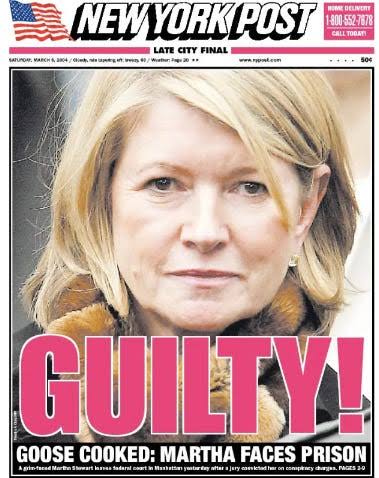
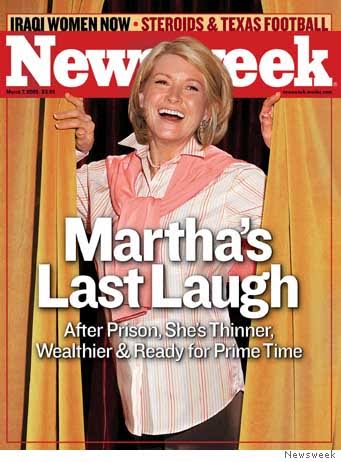
What I can say is Martha Stewart was as close to perfection as possible. Her hair was always perfect, and her outfit was always tasteful and appropriate. She was poised, well-spoken, made eye contact, and was an enormously successful media juggernaut. She was a cross between a Stepford wife and a media mogul, and many people, men and women alike, admired her. Many housewives idolized her perfect preparation of dishes for Thanksgiving, while men idolized her business cunning and ruthless ambition.
By the late 1990s and early 2000s, she had turned domestic perfection into a multimedia empire. Martha Stewart Living Omnimedia went public back in 1999, the heyday of the dot-com run-up. On the first day of trading, she became America’s first self-made female billionaire — on paper, anyway. She was everywhere: Martha Stewart magazines, TV shows, books, products, merch, you name it. That carefully crafted image of elegance made her a household name and a cultural icon.
And then, one fateful decision, and it all came crashing down.
Let’s talk a little bit about what she actually got in trouble for. In preparation for this article, I did my research, and I read James Comey’s book — he was the federal prosecutor who went after Martha Stewart and ultimately became the head of the FBI, a controversial figure in his own right. I’ll be frank and candid with you: he came across as a self-righteous prick to me through the entire book, but it is important to understand his version of the story.
On December 27, 2001, Martha Stewart sold 3,928 shares of ImClone Systems, a biotech company focused on a promising cancer drug. The sale was worth roughly $228,000, and it came one day before the FDA publicly announced it had refused to file ImClone’s application for the drug. Clearly bad news for the stock, and it dropped by about 16% in the following trading days. By selling in advance of that information, Stewart avoided approximately $45,673 in losses.
Now here’s where things get complicated. The CEO of ImClone, Samuel Waksal, was a friend of Martha’s. He had previously dated her daughter, Alexis. It turns out the CEO and members of his family were dumping their own shares that same day, having learned the bad news was imminent. Stewart’s long-time Merrill Lynch broker, Peter Bacanovic, learned of Samuel’s sell orders and, through his assistant Douglas Faneuil, passed word along to Stewart. She placed her order to sell shortly afterwards.
The plot thickens, of course, as federal investigators began looking into all these trades. When questioned, both Stewart and Bacanovic maintained that they had a pre-existing agreement to sell the stock if it ever fell below $60 a share. Prosecutors later argued this was a fabricated cover story, and Douglas, the assistant, eventually cooperated with the government and contradicted their account.
Here is a really key point: Stewart was never convicted of insider trading itself. When the verdict came down in March of 2004, after a massive, high-profile trial and a media frenzy, insider trading wasn’t even on the list. Nothing makes the sharks swim harder than blood in the water — especially the blood of a perfect deity!
Federal prosecutors, led by James Comey, charged her with obstruction of agency proceedings and making false statements. I’ll put that in English: James Comey charged her with lying to federal investigators. That — not the trade — is what she was convicted of.
Now, I need to frame this as a taxpayer. This ambitious man, James Comey, who would later become head of the FBI but at the time was the U.S. Attorney in Manhattan, spent millions of tax dollars going after Martha Stewart’s $45,000 stock trade. He realized he could not get her on an indictment for insider trading. Frankly, even if she had admitted to it — which she never did — it would have been nothing more than a slap on the wrist or a small financial penalty.
Instead, seeking the glitz and glamour of nailing one of the most famous people in the United States and attaching his name to it, he ferociously went after her for allegedly lying — which, to this day, Martha denies. In July of 2004, she was sentenced to five months in a federal prison camp, five months of home confinement with electronic monitoring, two years of supervised release, and a $30,000 fine. She reported to the minimum-security Alderson Federal Prison Camp in West Virginia in October of 2004 and was released in March of 2005.
In 2006, she settled related civil charges with the SEC, neither admitting nor denying the allegations. She paid roughly $195,000 in disgorgement, interest, and penalties, and accepted a five-year bar from serving as a director of a public company, with restrictions on certain officer roles. The underlying trade saved her less than $50,000. The cover-up cost her immeasurably more.
Now, in the court of public opinion, facts, logic, and reason do not matter. The crowd is a mob: dumb, angry, filled with emotion, lacking all reason. One of the things I find most interesting is that we, as human beings, are fully aware that men and women can lie, cheat, steal, and commit fraud, all in the hopes of a greater ambition. We know that our government is made up of these same flawed humans, just like you and me. Yet there’s an interesting psychological false floor, I’ll call it, where we believe — as a mob, anyway — that because the government said it, it must be true. In fact, we know that these leaders and decision-makers can be just as flawed as the rest of us.
I find that particularly interesting when the prosecutor, Mr. James Comey, was clearly willing to sacrifice huge amounts of taxpayer money to go after such an innocuous crime. Now, one could argue that all crimes need to be punished, and I don’t necessarily disagree, but this crime seems to be one of oversight: a small lie, allegedly or potentially. Knowing full well that an ultra-high-profile case like this would clearly raise his status, would he have spent so much of our taxpayer money if it weren’t Martha Stewart? I’ll put that question back to you.
If it wasn’t Martha Stewart — if it was John Doe who had taken the same exact actions — would he have gone after him with such zealous fervor? I would argue no.
The pinnacle of perfection, the princess of proper, was forced to resign as chairperson and CEO of the company she herself had founded — built around her, built on her name. For years, she was barred from key leadership and financial-reporting roles at her own company, in which she still owned a massive number of shares.
Personal relationships had obviously been strained — and that’s an understatement. Many people fled and wouldn’t speak to her anymore. Her daughter, Alexis, attended the trial and fainted when the guilty verdict was read. Later, Alexis visited her multiple times in prison. Long-time friendships faded away.
It’s amazing how this happens! This is a common trait. Massive failures, mistakes, collapses — up to and including prison time — are arguably the most effective filter in the world for understanding who your friends really are.
Understand that years before all this happened, she had gone through a divorce from her husband, Andrew. That had been painful, but this was a new level: public humiliation, disgrace, isolation.
Now, I happen to know a little bit about how she was treated in prison. It is reported through my sources that the guards there would not allow her to cook in the kitchen at the camp, and this is because they believed it would give her some sense of joy and satisfaction, as she is quite accomplished at cooking.
I think this is important to bring up because what is often underreported, or not reported at all, and what the public doesn’t seem to understand, is that the punishment within prison is significantly more severe than people realize. Not only will the officers and guards make your life miserable, they do nothing to help you find solace or redemption. They are out to harass you, cajole you, and make you miserable — and oftentimes your fellow residents will do the same, making each day dramatically more difficult than it needs to be, far above and beyond the sentence handed down by the judge.
Here is the turn. This is where everything changes. Stewart refused to disappear. I think she is truly a proper gangster — and to borrow a line often credited to Tony Soprano, “Everybody wants to be a gangster until it’s time to do gangster shit.” Martha Stewart is a gangster!
She began planning her return while she was still incarcerated and under home confinement, and within months of her release in 2005, she had a new syndicated daytime TV show, Martha. She hosted her own version of The Apprentice, and she published a book, The Martha Rules, a business-advice book drawn largely from her hardest lessons.
She is a perfect example of what I am advocating: a failure that you refuse to accept becomes the asset that you stand on to achieve higher heights. No one exemplifies this more than Martha Stewart. She returned to magazines, books, and media in general, gradually restoring her relationships with retailers and advertisers as they saw her recovery.
I want to be clear: it was not instantaneous. It was not seamless. This took years, not days or weeks. The media landscape was changing, and the traditional economics around her media empire were changing with it. While her business never fully returned to its pre-scandal peak, she eventually sold Omnimedia in 2015 for $353 million. However, Martha never stopped moving.
She diversified, licensing her name across all kinds of merchandise and home goods. She collaborated with major retailers and continued publishing. She developed CBD products, stayed active on television, and, most surprisingly, formed an unexpected and high-visibility friendship and creative partnership with the legendary Snoop Dogg. Their cooking show and joint appearances humanized her. This is important as we move into an era where authenticity matters. It introduced her to a younger audience and reframed her public image — from a perfectionist we could never live up to, into a resilient, authentic gangster of a human being that we all wanted to be more like.
She also didn’t take herself too seriously, appearing on the Comedy Central roast of Justin Bieber and holding her own with some pretty sharp-tongued humor. In her 80s, she was on the cover of the Sports Illustrated swimsuit issue, becoming the oldest cover model in the publication’s history. She kept writing books — dozens more after prison — kept launching products, and remained culturally relevant long after many expected her career to fade. Estimates of her net worth recovered to roughly $400 million. Still a little short of the $1 billion she was once worth, but understand: those were overly optimistic times. Irrational exuberance, some might say, of the late-’90s dot-com boom.
Most importantly, she refused to let the scandal become her final chapter. Instead, she treated it as a catastrophic setback to be managed, used, and ultimately outworked. It became the reason we all love her. Let me say this again for the people in the back: when the collapse happened, many people, including her closest friends, abandoned her. She refused to accept that judgment. She clawed her way back, never accepting it as a final verdict, never going quietly into the darkness — raging against that darkness and bringing her light back ever stronger. People love an underdog story. So no matter what collapse you are going through, I hope you find some hope within this one. Ultimately, her downfall is nothing more than a small footnote in an amazing life of accomplishment. I think that’s something we would all like for our own journey.
You haven’t missed your chance. Built by Failures is for people who aren’t finished yet. Real stories. Hard lessons. Second acts. Join The Rebuild.